
Key Takeaways
- Crossings carry duties ordinary roads do not, so a crash there gives you rules to test that a highway collision would not.
- The stopping zone is precise: within 50 feet of the nearest rail, and not closer than 15 feet.
- Some vehicles must stop at every crossing, including buses carrying passengers and placarded hazmat trucks.
- Federal law adds a gear rule. A driver required to stop must cross without changing gears, and must not shift while on the tracks.
- Heavy slow equipment must give the railroad advance notice before crossing at all.
- A violation is still not automatic liability. It is prima facie evidence of negligence, and causation must be proved.
The short answer
Yes, usually. Not because a railroad crossing makes a truck driver more careless, but because crossings are governed by specific duties that ordinary roadway rules do not impose. Where those duties applied and were not met, you have a concrete standard to measure conduct against instead of arguing about reasonableness in the abstract.
The strength comes from precision. “He should have been more careful” is an argument. “He was required to stop within 50 feet of the nearest rail and did not” is a rule.
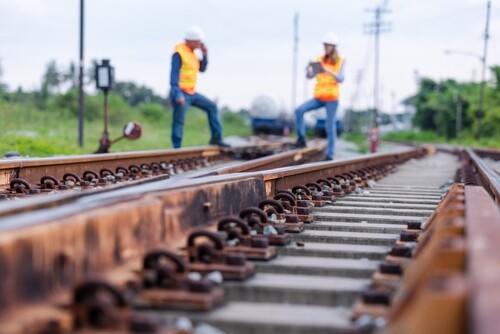
The Illinois rules at a crossing
Every driver, when a warning is given
Under 625 ILCS 5/11-1201(a), a driver approaching a crossing where stopping is not always required “must exercise due care and caution as the existence of a railroad track across a highway is a warning of danger.” Where any of the listed circumstances apply, the driver “shall stop within 50 feet but not less than 15 feet from the nearest rail” and shall not proceed until the tracks are clear and it is safe.
Those circumstances include a clearly visible electric or mechanical signal device warning of the immediate approach of a train, a lowered crossing gate or a flagman signaling, and a train emitting a warning signal that by its speed or nearness is an immediate hazard.
Certain vehicles, at every crossing
625 ILCS 5/11-1202(a) requires the drivers of certain vehicles to stop at all railroad grade crossings, within the same 50-foot and 15-foot band, and while stopped to listen and look for an approaching train before proceeding. The list includes any second division vehicle carrying passengers for hire, and school buses, which carry extra requirements such as turning off noise-producing accessories including heater blowers and defroster fans.
Heavy, slow equipment
625 ILCS 5/11-1203 goes further for crawler tractors, power shovels, derricks, rollers and other equipment with a normal operating speed of 10 miles per hour or less, or with low ground clearance measured against axle spacing. Such equipment may not cross at all without first giving notice of the intended crossing to a superintendent of the railroad and allowing reasonable time to provide protection.
The federal rule that applies on top
Because 625 ILCS 5/18b-105(b) adopts Part 392 of Title 49 as Illinois law, the federal crossing rule applies here too, and it is stricter in one respect people rarely know about.
49 CFR 392.10(a) provides that the driver of a listed commercial motor vehicle shall not cross tracks at grade unless he or she first stops within 50 feet of, and not closer than 15 feet to, the tracks, then “listens and looks in each direction along the tracks for an approaching train” and ascertains that none is approaching. Then this:
When it is safe to do so, the driver may drive the commercial motor vehicle across the tracks in a gear that permits the commercial motor vehicle to complete the crossing without a change of gears. The driver must not shift gears while crossing the tracks.
The vehicles caught by it include every bus transporting passengers, every commercial vehicle carrying any quantity of Division 2.3 chlorine, and every commercial vehicle required to be placarded for the listed hazardous materials classifications.
Why the gear rule matters more than it sounds
A heavy vehicle that stalls on the tracks is the classic grade crossing catastrophe, and the gear requirement exists precisely to prevent it. So where a placarded or passenger-carrying vehicle was struck while on the crossing, two questions follow immediately: did it stop where the rule requires, and did it cross in a gear that would carry it clear without shifting?
Both are answerable from evidence rather than testimony. Engine control data records gear selection and speed, and it is exactly the material a preservation letter needs to reach before the vehicle is repaired or the data cycles out.
What a violation actually proves
The same limit applies here as anywhere else in Illinois. Violating a statute designed to protect life or property is prima facie evidence of negligence, not negligence in itself, it is rebuttable, and proximate cause still has to be proved. That rule comes from Davis v. Marathon Oil Co., 64 Ill. 2d 380 (1976), and it is reflected in IPI Civil 60.01.
So a missed stop is powerful, but it is a starting point. If the train was not yet visible or audible and the collision happened for an unrelated reason, the violation may not be what caused the crash. We go through that distinction in our post on whether a truck citation wins your case.
Who else may be responsible
Crossing cases are unusual in how many parties can be involved, and identifying them early matters because each carries its own deadline.
- The driver and the motor carrier, under the rules above and the ordinary standards of care.
- A shipper or broker, where routing or scheduling put a placarded vehicle on that road.
- The railroad, in relation to the crossing surface, sight lines, vegetation and the operation of warning devices.
- A public body, where the approach roadway, signage or signal timing is the responsibility of a municipality, county or the State.
That last one is the reason a crossing case needs early legal attention rather than eventual legal attention. Where a local public entity is a defendant, 745 ILCS 10/8-101(a) gives you one year, not the two years under 735 ILCS 5/13-202 that applies to the carrier.
Why crossings produce worse outcomes
Two physical facts sit behind the legal ones, and they explain why these collisions are so often catastrophic.
A train cannot stop for you. A freight train traveling at speed needs a stopping distance measured in thousands of feet, so by the time a crew sees a vehicle on the crossing the outcome is largely determined. Every rule above is written on the assumption that avoidance is the driver’s job, not the train’s.
The geometry works against long vehicles. A tractor-trailer needs far more clear time than a car to place itself entirely beyond the tracks, and a low-clearance trailer on a humped crossing can ground out. That combination is why the federal rule bothers to specify a gear rather than simply requiring care.
For an injured person the practical consequence is that these cases tend to involve severe injuries and multiple defendants at once, so identifying every responsible party early affects not only liability but whether there is enough insurance to cover the loss.
Evidence specific to a crossing
- Signal and gate maintenance records, including activation logs where the crossing is equipped.
- The locomotive’s event recorder and forward-facing camera, held by the railroad rather than the carrier.
- Sight line evidence, photographed from the driver’s actual approach and eye height, before vegetation is cut back.
- The crossing surface and approach grade, which is what causes a low-clearance vehicle to hang up.
- The truck’s engine data, for speed, braking and gear selection.
Almost none of this is in the police report, and most of it is held by parties with no obligation to volunteer it.
Timing is the difference between having this material and arguing about its absence. Locomotive recorder data and signal activation logs sit on retention cycles set by the railroad, vegetation is cut back seasonally, and a damaged vehicle is repaired or salvaged within weeks. A preservation request addressed to each party separately is the only step that reliably stops those clocks.
Hurt in a truck crash at an Illinois rail crossing?
Crossing crashes tend to cause severe injuries and involve several defendants, each with its own deadline. A claim against a public body for the approach or signals has one year.
Call 847-800-8978Free case review →
Free personal injury consultation. No fee unless we win.
अक्सर पूछे जाने वाले प्रश्नों
Where exactly must a driver stop at an Illinois railroad crossing?
Within 50 feet of the nearest rail but not less than 15 feet from it. That band appears in 625 ILCS 5/11-1201 for drivers generally when a warning is given, in 625 ILCS 5/11-1202 for vehicles that must stop at every crossing, and in the federal rule at 49 CFR 392.10 for listed commercial vehicles.
Which vehicles have to stop at every railroad crossing?
Under 625 ILCS 5/11-1202 they include any second division vehicle carrying passengers for hire and school buses, which must also turn off noise-producing accessories such as heater blowers and defroster fans. The federal rule at 49 CFR 392.10 adds every bus transporting passengers and commercial vehicles placarded for the listed hazardous materials classes.
Is there really a rule about changing gears on the tracks?
Yes. Under 49 CFR 392.10(a) a driver required to stop may cross only in a gear that permits the vehicle to complete the crossing without a change of gears, and must not shift gears while crossing the tracks. The rule exists to prevent a heavy vehicle stalling on the crossing.
Does a truck driver’s crossing violation mean the case is won?
No. In Illinois a statutory violation is prima facie evidence of negligence rather than negligence in itself. It can be rebutted, and you still have to prove the violation was a proximate cause of the collision and of your injuries.
Can the railroad be liable rather than the trucking company?
It can be, in addition or instead. A railroad’s responsibility can extend to the crossing surface, sight lines, vegetation and the operation of warning devices. A public body may also be involved where the approach roadway, signage or signal timing is its responsibility, and that shortens the deadline to one year under 745 ILCS 10/8-101(a).
What evidence matters most after a crossing collision?
Signal and gate maintenance and activation records, the locomotive event recorder and forward-facing camera held by the railroad, sight line photographs taken from the driver’s actual approach before vegetation is cut back, the crossing surface and approach grade, and the truck’s engine data for speed, braking and gear selection.
Talk to an Elmwood Park truck accident lawyer
Crossing cases reward speed more than most. The railroad holds evidence the carrier does not, a public body may hold more, and the physical scene, particularly sight lines and vegetation, changes with the season.
If you were hurt at a crossing in Elmwood Park, Oak Lawn, Skokie, Niles, Orland Park or anywhere in Cook County, Lawyer Furqan will identify every party that may be responsible and get preservation letters out to each of them. Where a crossing collision proves fatal, a separate wrongful death claim runs alongside.
Sources and authorities cited
- 625 ILCS 5/11-1201 · obedience to a signal indicating the approach of a train, and the 50-foot and 15-foot stopping band
- 625 ILCS 5/11-1202 · vehicles that must stop at all grade crossings
- 625 ILCS 5/11-1203 · moving heavy or slow equipment, and notice to the railroad superintendent
- 49 CFR 392.10 · railroad grade crossings, stopping required, and the gear rule
- 625 ILCS 5/18b-105(b) · Illinois adopts Part 392 and other parts of 49 CFR by reference
- IPI Civil 60.00, Statutory Violations · citing Davis v. Marathon Oil Co., 64 Ill. 2d 380 (1976)
- 745 ILCS 10/8-101(a) · one-year limitation, local public entities; 735 ILCS 5/13-202 · two years
This article is general legal information about Illinois law, not legal advice, and creates no attorney-client relationship. Whether a crossing duty applied depends on the facts of each case, and nothing here predicts a result.