
Key Takeaways
- An Elmwood Park owner owes you reasonable care if you were lawfully on the property. Illinois abolished the invitee and licensee split, so a guest and a customer are owed the same duty.
- Liability turns on notice. You generally must show the owner knew about the hazard, or would have found it using ordinary care.
- If the business created the hazard, notice may not be required at all.
- Open and obvious hazards usually carry no duty to warn, unless you were distracted or had to encounter the danger anyway.
- Winter falls follow a separate rule: generally no duty to remove a natural accumulation of snow or ice.
- Your deadline may be one year, not two, for claims against the Village, Cook County, or any local public entity.
- Partial fault is survivable to a point. You recover if you are 50% or less responsible. At 51%, you recover nothing.
The short answer
An Elmwood Park property owner is liable when four things line up: you were lawfully on the property, a dangerous condition existed, the owner knew or should have known about it, and they failed to fix it or warn you. Everything else, including the winter rules, is a variation on those four. Our slip and fall practice is built around proving them.

The duty an Illinois property owner owes you
Before September 1984, the care you were owed depended on whether you counted as an “invitee” or a “licensee.” The Premises Liability Act ended that. Under 740 ILCS 130/2 the duty owed to lawful entrants is “reasonable care under the circumstances regarding the state of the premises or acts done or omitted on them.” In the words judges read to juries:
“It was the duty of [the owner] to exercise ordinary care to see that the property was reasonably safe for the use of those lawfully on the property.”
Illinois Pattern Jury Instruction 120.02
A dinner guest, a delivery driver, and a paying customer are owed the same care. Trespassers are not, though an owner who knows or should know they are present owes ordinary care. These are the same Illinois negligence principles that run through every injury claim, applied to land. Our premises liability page covers the full range.
What you actually have to prove
Illinois adopted section 343 of the Restatement (Second) of Torts in Genaust v. Illinois Power Co. An owner is liable for a condition on the land only if these hold, and you connect the failure to a real injury:
| What must be shown | What that means in a real case |
|---|---|
| Knowledge of the hazard | They knew, or with reasonable care would have discovered, the condition and its unreasonable risk |
| Expectation you would be hurt | They should have expected visitors to miss the danger, or fail to protect themselves from it |
| Failure to use reasonable care | They did not fix it, guard it, or warn about it within a reasonable time |
| Injury and causation | You were hurt, and that failure was a proximate cause of it |
For the evidence that carries each of these, see what must be proven in an Elmwood Park slip and fall claim.
Notice is where most claims are won or lost
The most contested question in a fall case is whether the owner had notice. Illinois recognizes two kinds:
- Actual notice. Somebody told them, or they saw it: a prior complaint, a work order, an employee who walked past.
- Constructive notice. It was there long enough that ordinary care would have found it. Without evidence the owner knew or should have discovered the condition, liability cannot be imposed.
This is why a puddle sitting for two hours is a very different case from one spilled ninety seconds earlier, and why we move fast to preserve inspection logs and footage before they cycle out.
One exception matters. When the condition arose from the owner’s own conduct or the way the business operates, Illinois courts have held you need not prove notice at all. A crate stacked so it spills, a floor mopped without cones, produce that ends up underfoot: the owner created the hazard, so asking whether they knew misses the point.
What if the hazard was obvious?
As a general rule, an Illinois owner has no duty to warn of open and obvious conditions. If a reasonable person would have seen and appreciated the danger, the law usually requires no sign. Two well established exceptions decide a lot of cases:
- Distraction (Ward v. Kmart Corp.). If the owner should suspect you would be preoccupied and miss the danger, they still owe reasonable care. In Ward the plaintiff carried a large mirror out of a store and struck a post beside the door.
- Deliberate encounter (LaFever v. Kemlite Co.). If the owner can expect you to face the hazard anyway because the advantages outweigh the risk, a duty exists. This often covers workers whose job requires crossing it.
Whether a condition really was open and obvious is often a question of fact for a jury, not something a defendant declares.
Where these falls actually happen
Most Elmwood Park fall claims have nothing to do with weather:
| Hazard | What usually decides the claim |
|---|---|
| Spills and wet floors | How long it sat there, inspection routines, whether staff created it |
| Stairs, handrails, single steps | Building code compliance, missing or loose rails, prior complaints |
| Torn carpet, loose tile, uneven flooring | Maintenance history and how visible the defect was |
| Parking lot potholes and heaved pavement | Who maintains the lot, inspection records, whether it is Village property |
| Cords, merchandise, debris in walkways | Almost always created by the business, so notice may not be required |
Winter falls follow a different rule
Snow and ice are the big exception to everything above, and the rule surprises nearly everyone who calls after a winter fall.
“As a general rule, property owners have no duty to remove natural accumulations of snow, ice or melt water from their premises.”
Illinois Pattern Jury Instruction 125.00, citing Riccitelli v. Sternfeld, 1 Ill. 2d 133 (1953)
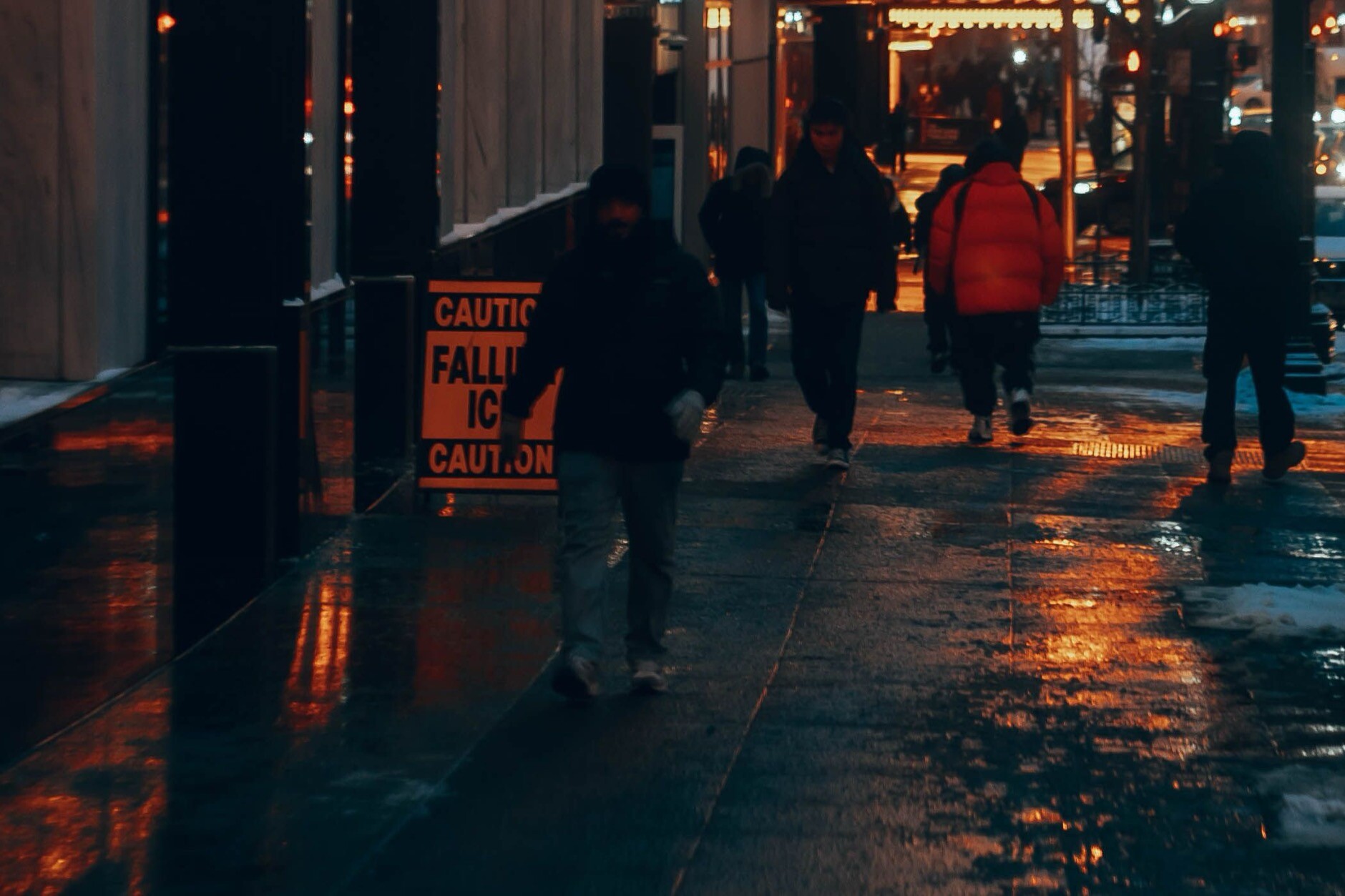
Winning a winter case usually needs an unnatural accumulation: ice from a broken downspout, a badly drained surface, or snow piled so its runoff refreezes across a path. The test: with identical weather but a properly maintained property, would the ice still have been there?

Two local points people get wrong. First, Elmwood Park’s 2-inch snow rule does not make an owner liable to you. It governs Village snow operations and parking. A municipal ordinance requiring owners to clear sidewalks “is an ordinance for the benefit of the municipality. Such an ordinance does not create a duty for the landowners” (Klikas v. Hanover Square Condominium Association). An owner can be fined and still owe you nothing civilly. More in does Elmwood Park’s snow rule make property owners liable.

Second, the Snow and Ice Removal Act, 745 ILCS 75/2, protects a residential owner who shovels: clear an abutting sidewalk imperfectly and you are not liable unless the conduct was willful or wanton. That shield is residential only, which is why commercial property is where most winnable winter cases live. Businesses often have snow removal contracts, and a contract can create a duty the common law would not.
You may have one year, not two
Almost every article says two years. That is right against a private owner, under 735 ILCS 5/13-202, and dangerously wrong if you fell on public property. Under the Tort Immunity Act, 745 ILCS 10/8-101, a claim against a local public entity must be filed within one year. The duty is the same; only the clock changes.

| Where you fell | Likely defendant | ഡെഡ്ലൈൻ |
|---|---|---|
| A store’s lot or entrance | Private owner or management company | 2 വർഷം |
| A neighbor’s front walk | Private homeowner | 2 വർഷം |
| A public sidewalk kept by the Village | Village of Elmwood Park | 1 വർഷം |
| A park path or school grounds | Park district / school district | 1 വർഷം |
| A county road or facility | Cook County | 1 വർഷം |
Sidewalk cases are the trap. The concrete in front of a house may be Village property while the owner is expected to shovel it, so who you sue and how long you have is not obvious from standing on it. See filing your fall claim within the deadline, and if a fall was fatal, wrongful death claims run on their own clock.
Being partly at fault does not end your claim
Illinois uses modified comparative negligence under 735 ILCS 5/2-1116. Your compensation drops by your share of fault, and you are barred only once you cross 51%.

If your damages are $100,000 and a jury finds you 30% responsible, you recover $70,000. At 51% you recover nothing. This is why adjusters ask about your footwear, your phone, and why you used that entrance. Those questions build a fault percentage, and they are the best reason not to give a recorded statement first. More in what modified comparative negligence means for fall claims, and whether partly at-fault pedestrians can still recover.
What to do after a fall
Notice is proved with records that get overwritten and conditions that get cleaned up. The first few days matter more than almost anything later.
- Photograph the hazard before anything changes, including what is above and around it: a leaking ceiling, a missing handrail, a burnt-out light.
- Get medical attention the same day. A gap before the first treatment note is the most common way a real injury gets devalued.
- Report it in writing and ask for a copy of the incident report.
- Record who owns and maintains the property, including any cleaning or snow removal contractor, and get witness names and what they knew beforehand.
- Keep the shoes and clothing you wore, unwashed, and give no recorded statement before legal advice.
Pro tip: Ask, in writing, that the property preserve its video and inspection logs. Many systems overwrite in days, and that footage is often the clearest proof of how long a hazard sat there.
Injured in a fall on property in Elmwood Park?
Footage and inspection logs that prove your injury claim can cycle out, so the first few days matter most. A claim against the Village or Cook County may have one year, not two.
Call 847-800-8978Free case review →
Free personal injury consultation. No fee unless we win.
പതിവ് ചോദ്യങ്ങൾ
What makes a property owner liable for a fall in Illinois?
You must have been lawfully on the property, and a dangerous condition must have existed that the owner knew about or should have discovered using ordinary care. They must then have failed to fix, guard, or warn about it, and that failure must have caused your injury. Under 740 ILCS 130/2 the duty is reasonable care, the same whether you were a customer, a guest, or a delivery driver.
അപകടത്തെക്കുറിച്ച് ഉടമയ്ക്ക് അറിയാമായിരുന്നുവെന്ന് ഞാൻ തെളിയിക്കേണ്ടതുണ്ടോ?
Usually yes, in one of two ways. Actual notice means someone told them or they saw it. Constructive notice means it existed long enough that ordinary care would have turned it up. One exception matters: when the hazard arose from the owner’s own conduct or the way the business operates, Illinois courts have held you need not prove notice at all, because they created it.
What if the hazard was open and obvious?
An Illinois owner generally has no duty to warn about a condition a reasonable person would see and appreciate. Two exceptions matter. Under Ward v. Kmart Corp., a duty remains if the owner should expect you to be preoccupied and miss the danger. Under LaFever v. Kemlite Co., it remains if they should expect you to face the hazard anyway. Whether it really was open and obvious is often a jury question.
What is the statute of limitations on a slip and fall in Illinois?
Two years from the date of injury against a private property owner, under 735 ILCS 5/13-202. If you fell on property owned or maintained by a local public entity, such as the Village of Elmwood Park, Cook County, or a park or school district, the deadline drops to one year under 745 ILCS 10/8-101. Sidewalk ownership is often unclear, so do not assume you have two years.
Is a property owner liable if they never shoveled?
Usually not, by itself. There is generally no duty to remove naturally fallen snow or ice, so failing to shovel is typically not negligence. Liability attaches when the accumulation was unnatural, when a contract created a removal duty, or when the owner undertook removal and made things worse. Under 745 ILCS 75/2 a residential owner who shovels is immune unless the conduct was willful or wanton.
Does Elmwood Park’s snow ordinance make a property owner liable for my fall?
No, not on its own. Illinois courts hold that municipal snow removal ordinances exist for the benefit of the municipality and create no private duty to injured pedestrians (Klikas v. Hanover Square Condominium Association). An owner can be cited by the Village and still owe you nothing civilly, though the ordinance remains evidence of notice.
How much is a slip and fall case worth in Illinois?
There is no average that means anything for your case. Value depends on the severity of your injuries, medical bills, lost income, the liability evidence, available coverage, and your own fault percentage. Any lawyer quoting a number before reviewing your records is guessing. See our case results. Past results do not guarantee or predict a similar outcome in any future case.
Talk to an Elmwood Park slip and fall lawyer
Fall cases turn on details that disappear fast: an inspection log, a maintenance record, video that overwrites in a week. Whether an owner is liable is rarely obvious from the floor you landed on, and it is not for an adjuster to decide.

If you fell on someone else’s property in Elmwood Park, Oak Park, Melrose Park, River Forest, or anywhere in Cook County, Lawyer Furqan will look at the conditions and tell you straight whether you have a case.
Sources and authorities cited
- Illinois Pattern Jury Instructions, Civil, 120.00, Premises and 125.00, Liability for Falls on Snow and Ice (Illinois Courts)
- Premises Liability Act, 740 ILCS 130/2 · Snow and Ice Removal Act, 745 ILCS 75/2
- 735 ILCS 5/13-202 · 735 ILCS 5/2-1116 · 745 ILCS 10/8-101
- Genaust v. Illinois Power Co., 62 Ill. 2d 456 (1976) · Ward v. Kmart Corp., 136 Ill. 2d 132 (1990) · LaFever v. Kemlite Co., 185 Ill. 2d 380 (1998)
- Riccitelli v. Sternfeld, 1 Ill. 2d 133 (1953) · Klikas v. Hanover Square Condominium Ass’n, 240 Ill. App. 3d 715 (1st Dist. 1992)
This article is general legal information about Illinois law, not legal advice, and does not create an attorney-client relationship. Outcomes depend on the specific facts of each case.