
Key Takeaways
- As a passenger, comparative fault rarely touches you. The argument is between the drivers.
- It still decides your money, because it decides which policy pays and how much exists.
- Both drivers blaming each other can help you, not hurt you.
- Medical expenses are joint and several against every liable defendant.
- If you were the rideshare driver, the analysis is entirely different.
The rule in one paragraph
Illinois uses modified comparative negligence. Under 735 ILCS 5/2-1116 your damages are reduced by your share of the fault and barred only where that share is more than 50%. At exactly 50% you recover half. The rule is set out in full, with worked figures, in the Illinois 51% fault rule.
This article is about what that rule actually does in a rideshare case, which is not what most people expect.
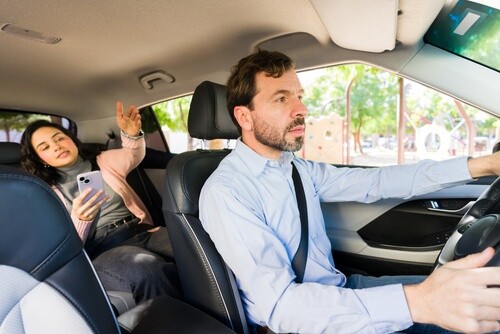
If you were the passenger
Start with the good news, because it is genuinely unusual. A rideshare passenger is almost never at fault for the collision. You were not driving, you had no control over speed, following distance or lane choice, and you owed no duty to other road users in respect of any of it.
So the reduction that dominates most injury claims usually does not arise. What the fault argument decides instead is who pays you:
- If the rideshare driver was at fault, the applicable period under 625 ILCS 57/10 determines the cover. With a passenger on board that is $1,000,000 in primary liability.
- If a third driver was at fault, their own policy responds first, and it may be far smaller. Illinois requires only $25,000 for one person under 625 ILCS 5/7-203.
- If both were at fault, apportionment under 735 ILCS 5/2-1117 decides who can be pursued for what.
That third case is often the best outcome for a passenger, which is counterintuitive. It brings the rideshare policy into a case that might otherwise have been limited to a small personal policy.
Why the drivers blaming each other helps you
Passengers frequently find it distressing that both drivers immediately blame the other. In a claim it usually works in your favor.
Each driver is trying to move their own percentage down, and in doing so each produces evidence establishing the other’s negligence. Because you are not competing with either of them for a share of the blame, the material they generate is largely useful to you and costs you nothing.
Under 735 ILCS 5/2-1117, every defendant found liable is jointly and severally liable for past and future medical and medically related expenses, so that category can be recovered in full from any of them regardless of percentage. For other damages, a defendant at 25% or more is jointly and severally liable, while one below 25% pays only its own share. See multi-vehicle crash claims.
The arguments that are made against passengers
They are few, and they go to damages rather than to the collision:
- Seat belt use. Note that 625 ILCS 5/12-603.1(c) provides that failure to wear a seat belt is not evidence of negligence and may not be used to reduce recovery.
- Gaps in treatment, used to argue the injury was minor or came from elsewhere.
- Pre-existing conditions, answered with medical evidence rather than argument.
- Distracting the driver, which is occasionally raised and rarely goes anywhere without evidence.
Only the last touches fault at all, and the first is answered by statute.
If you were the rideshare driver
Here the ordinary analysis applies in full, and the stakes are higher than for an ordinary motorist:
- Your own percentage reduces your recovery, and above 50% removes it.
- Your app status decides which cover applies to you, as much as it does for your passenger.
- Personal policies commonly exclude carrying passengers for payment, which is why 625 ILCS 57/10(b)(2) requires contingent cover from the company in Period 1.
How fault percentages are set in practice is covered in how fault is decided, and the periods in Illinois rideshare insurance requirements.
The standard of care owed to passengers
Since 1 January 2024 rideshare companies have been treated as common carriers in Illinois, following the expiry of the statutory carve-out. That raises the standard of care owed to passengers above ordinary negligence, which matters to what a passenger has to prove. See Illinois common carrier law for rideshare passengers.
Deadlines
Two years under 735 ILCS 5/13-202; one year where a local public entity or its employee is a defendant under 745 ILCS 10/8-101(a); one year against the CTA under 70 ILCS 3605/41. See the Illinois filing deadlines.
Hurt as a passenger while both drivers blame each other?
A third driver at fault may carry as little as $25,000 for one person, so which policy pays your injury claim turns on fault and app status.
Call 847-800-8978Free case review →
Free personal injury consultation. No fee unless we win.
Frequently Asked Questions
Does comparative negligence affect me as a rideshare passenger?
Rarely in the way it affects drivers. A passenger is almost never at fault for the collision, so the reduction under 735 ILCS 5/2-1116 usually does not apply. What the fault argument decides instead is which driver, and therefore which insurance policy, pays you.
Both drivers are blaming each other. Is that bad for me?
Usually the opposite. Each driver is trying to reduce their own percentage and in doing so produces evidence of the other’s negligence. Because you are not competing with either of them for a share of blame, that material is largely useful to you.
Who pays if the other driver caused the crash rather than my rideshare driver?
The other driver’s policy responds first, and it may be small, since Illinois requires only $25,000 for bodily injury to one person under 625 ILCS 5/7-203. Where both drivers share fault, 735 ILCS 5/2-1117 governs which of them can be pursued for the whole judgment.
Can not wearing a seat belt reduce my claim?
No. Under 625 ILCS 5/12-603.1(c) failure to wear a seat belt is not evidence of negligence and may not be used to reduce recovery in a civil action.
Who pays my medical bills if several parties are at fault?
Any liable defendant. Under 735 ILCS 5/2-1117 all defendants found liable are jointly and severally liable for past and future medical and medically related expenses, whatever their individual percentage of fault.
What if I was the rideshare driver rather than the passenger?
Then the ordinary analysis applies: your damages are reduced by your share and barred above 50%. Your app status also determines which coverage applies to you, and because personal policies commonly exclude carrying passengers for payment, 625 ILCS 57/10(b)(2) requires the company to maintain contingent coverage during Period 1.
Talk to an Elmwood Park rideshare accident lawyer
For a rideshare passenger, the fault fight is mostly other people’s problem. The part that matters to you is which policy it lands on, because that determines whether the available insurance is measured in tens of thousands or in millions.
If you were hurt in a rideshare crash in Elmwood Park, Oak Lawn, Skokie, Niles, Orland Park or anywhere in Cook County, Lawyer Furqan will pursue every driver and every policy in play rather than settling with whoever answers first.
Sources and authorities cited
- 735 ILCS 5/2-1116 · comparative negligence; 2-1117 · apportionment and medical expenses
- 625 ILCS 57/10 · rideshare coverage periods, including contingent cover in Period 1
- 625 ILCS 5/7-203 · minimum liability limits
- 625 ILCS 5/12-603.1(c) · seat belt non-use is not evidence of negligence
- 735 ILCS 5/13-202, 745 ILCS 10/8-101(a), 70 ILCS 3605/41 · deadlines
This article is general legal information about Illinois law, not legal advice, and creates no attorney-client relationship. Nothing here predicts a result in any particular case.